
With each passing time, companies consider hiring candidates all over the world. The talent can be picked anywhere globally. Before you hire, the right employment structure matters the most to understand. Don’t underestimate this step, or you’ll miss out on something very important. Avoid making a poor choice in the eor vs peo decision. This can trigger a lot of things that you don’t even imagine. You’ll be trapped in compliance penalties and unexpected tax exposure. The risk of benefit gaps and legal disputes will always be on your mind. It seems quite like a simple HR decision. But it can quickly turn into a costly operational problem.
You’ve observed many blogs oversimplify the topic by saying, EOR is global, PEO is for the US. However, in actuality, the decision involves legal and operational differences. We’ve provided our detailed insights in this guide. Helping you to understand the EOR and PEO comparison practically. Not only this, but we’re going to walk you through legal structure differences, risk and compliance ownership, hiring workflow and operational impact, cost implications over time, and scalability limits and growth strategy.
What Does PEO Mean?
You should know the PEO’s meaning with awareness of how it works before a model comparison. A PEO or Professional Employer Organization partners with businesses to manage HR operations. The core operations they handle are payroll processing, benefits administration, tax filings, HR compliance support, and workers’ compensation management. They operate through a co-employment relationship rather than becoming the employer.
How Co-Employment Works?
The company you own remains the legal employer under a PEO. The PEO becomes the administrative employer. This way, responsibilities are split between both parties. Your company handles hiring decisions, worker management, job responsibilities, and their performance. On the other hand, the PEO handles employees’ payroll processing, HR administration, worker benefits management, and regulatory support.
Compliance responsibility remains shared between them. Your company may face liability if legal issues arise. It could be in the form of wage disputes or regulatory violations.
IRS-Certified CPEO Structure:
Many reputable PEOs operate as CPEOs – Certified Professional Employer Organizations under IRS guidelines. This certification means the PEO meets strict financial standards. The IRS recognizes payroll tax handling on a formal basis. The clients receive stronger compliance support.
Organizations still must maintain state registrations where employees work. You require extra payroll registrations and compliance filings if you hire in multiple US states.
Comparing this model with what EOR is, companies evaluate whether they are ready for domestic HR optimization or broader geographic expansion.
What Does an Employer of Record Mean?
First, understand what EOR is to understand global hiring. An EOR or Employer of Record is a third-party organization. They are hired to employ workers legally on the company’s behalf. Businesses use this model to hire employees in other countries. No requirement of creating a legal entity there. The EOR becomes the legal employer. They take charge of job contracts, payroll and taxes, benefits administration, and local labor law compliance.
Still, your company manages the core tasks. Including daily work, performance management, team collaboration, and strategic leadership. They are all the duties of your company to fulfill.
Permanent Establishment Risk Mitigation:
EOR involves one major advantage that is permanent establishment or PE risk. Tax authorities may classify that presence as a taxable business entity if a company hires workers in another country. Even without the proper legal structure. The role of an EOR prevents this by employing workers through an existing local entity. The existence of EOR manages payroll and employment compliance on a local basis.
Intellectual Property Across Borders:
EOR providers also ensure employment contracts correctly assign intellectual property rights according to local laws. This protects companies when employees create work in different jurisdictions.
Faster Market Testing
Many startups and scaleups use EOR services to test new markets quickly.
Instead of waiting months to register an entity, businesses can hire employees in days and evaluate demand before committing to long-term expansion.
This flexibility often becomes the deciding factor in a peo vs eor comparison.
EOR vs PEO: Legal & Structural Differences That Actually Matter
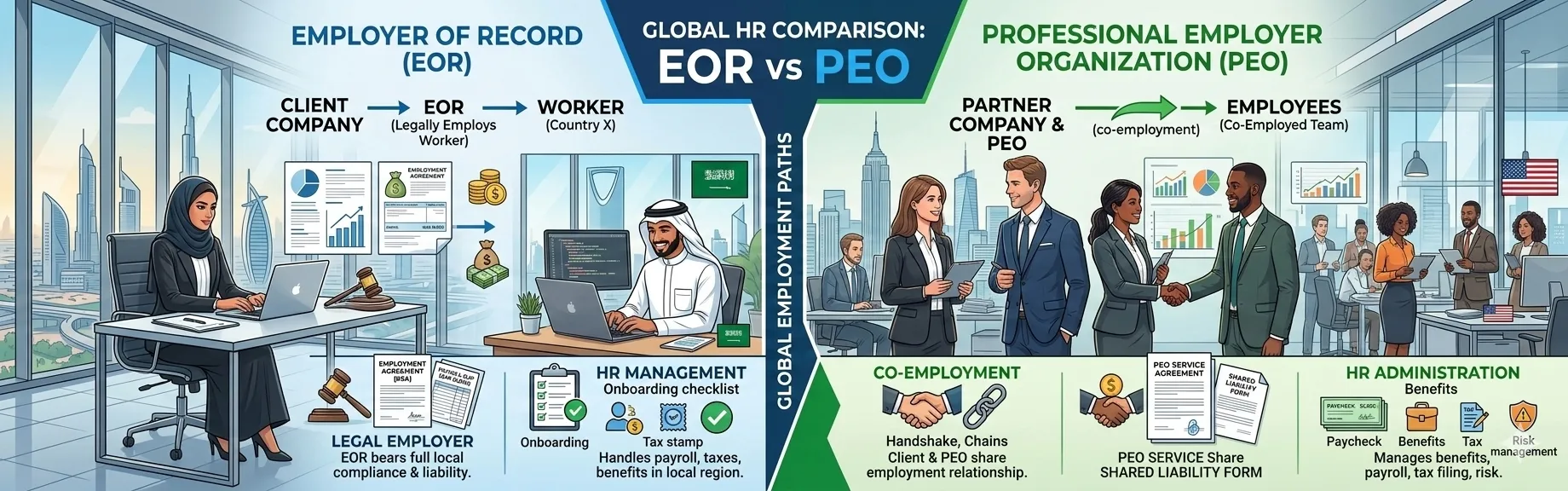
At first glance, the difference between an EOR and a PEO may seem simple. But several deeper legal and structural factors influence which model fits your business.
Let’s break down the key differences in the eor vs peo decision.
Legal Employer vs Co-Employment
The biggest structural difference lies in the legal employer relationship.
Factor |
PEO |
EOR |
| Legal employer | Your company | EOR provider |
| Employment contracts | Signed by your company | Signed by EOR |
| Liability structure | Shared responsibility | EOR assumes compliance risk |
| HR administration | PEO supports HR | EOR manages HR compliance fully |
If termination disputes occur:
- Under a PEO, your company typically manages termination decisions and legal risk.
- Under an EOR, the provider handles contract compliance and local labor requirements.
Government audits follow the same pattern. In an EOR structure, the provider manages regulatory obligations in that country.
Entity & Permanent Establishment Risk
Another key difference involves business entity requirements.
With a PEO:
- You must already have a registered legal entity.
- You must maintain registrations in each operating state or country.
With an EOR:
- No entity setup is required.
- The EOR’s local entity legally employs workers.
This structure protects companies from accidental tax exposure or permanent establishment risk.
Control vs Delegation
A common misconception says that EOR providers control employees.
That’s incorrect.
In both models:
- Your company controls daily work
- You set goals and manage performance
- Employees report directly to your managers
The EOR or PEO simply manages the employment framework behind the scenes.
Hiring Process Differences: Operational Workflow Comparison
Beyond legal structure, the hiring workflow also differs between the two models.
Contract Generation
EOR
- Generates compliant contracts for each country
- Automatically adapts to local labor laws
- Handles employment documentation
PEO
- Your company creates the employment offer
- The PEO assists with payroll setup and HR documentation
Onboarding Speed
| Hiring Factor | PEO | EOR |
| Entity requirement | Required | Not required |
| Hiring timeline | Weeks | Days |
| Compliance checks | Shared | Fully handled by EOR |
Companies expanding globally often choose EORs because they remove the delay caused by entity registration.
Payroll Approval Workflows
Under an EOR:
- The provider processes payroll in local currency
- Your team reviews and approves payments through a centralized platform
With a PEO:
- Your internal HR team inputs payroll data
- The PEO processes taxes and payroll filings
Termination Process
Employee termination becomes more complex across borders.
An EOR ensures:
- Local notice periods are followed
- Severance obligations meet legal requirements
- Documentation complies with labor laws
Benefits & Insurance: How Coverage Actually Differs
Both models support employee benefits, but the structure differs significantly.
Benefits Through a PEO
PEOs pool thousands of employees across clients. This scale allows them to negotiate strong US benefit plan, which is one of the key benefits of a PEO for growing businesses.
Common offerings include:
- Health insurance
- Dental and vision coverage
- Retirement plans (401k)
- Disability insurance
- Life insurance
This bargaining power can lower benefit costs for smaller companies.
Benefits Through an EOR
Global employees require benefits tailored to each country’s regulations.
EOR providers typically manage:
- Statutory benefits required by law
- Health insurance is required
- Pension contributions
- Paid leave regulations
- Workers’ compensation coverage
Workers’ Compensation Differences
In the US, PEOs often include workers’ compensation coverage within their programs.
For international employees, EOR providers handle country-specific insurance requirements.
Cost Comparison: Short-Term vs Long-Term Financial Impact
At first glance, both models charge per-employee service fees. However, the overall financial impact differs significantly.
| Cost Factor | PEO | EOR |
| Entity setup | Required | Not required |
| Service fees | Per employee per month | Per employee per month |
| HR overhead | Internal HR team needed | Reduced HR workload |
| Compliance risk | Shared liability | Provider absorbs risk |
| Expansion costs | High for international hiring | Predictable costs globally |
Hidden Costs with PEO
Many companies overlook additional expenses such as:
- Internal HR staff time
- Multi-state registration requirements
- Legal consulting fees
- Compliance management
Entity Maintenance Costs
Setting up foreign entities also brings ongoing costs:
- Accounting services
- Tax reporting
- Local payroll management
- Corporate filings
Exit Costs
If a company closes a foreign entity later, it may face:
- Dissolution fees
- Legal processes
- Regulatory audits
EOR models eliminate most of these risks.
Scalability & Growth Strategy Differences
Your hiring model should support future growth—not limit it.
Domestic Scaling Across Multiple States
PEOs work well for companies expanding across the United States.
However, scaling across multiple states still requires:
- State payroll registrations
- Labor law compliance monitoring
- Tax reporting obligations
As operations expand, administrative complexity increases.
International Market Testing
EOR providers excel when companies explore new markets.
Businesses can:
- Hire a small team in a new country
- Test demand and operations
- Evaluate long-term expansion potential
If growth becomes sustainable, companies may eventually create their own entity and transition employees.
Scenarios Where PEO is a Great Fit?
When to choose a PEO is not a hard decision to make. It depends on your company’s current structure. A PEO works best when your business operates primarily in the US. PEO must be your ultimate solution if you already have legal entities established. Want HR efficiency and administrative support? Adapt PEO! They are an ideal option if your internal team manages employee operations. They also streamline payroll, benefits, and strengthen compliance support. The PEO model may create additional complexity later if international expansion becomes part of your strategy.
When to Use an EOR?
Has expansion become a priority for your business? Then, you should explore when to use an Employer of Record. An EOR works well for companies that want to hire their first employee in a new country. You can opt for an EOR’s support if you want to build remote-first global teams. Need to test international markets quickly? EOR is the best option for you! They’re your must-pick if you want to avoid permanent establishment risk.
Let’s understand it with an example:
Businesses expanding in the UAE often explore an Employer of Record in Dubai. This way, they bypass complex local entity registration.
Modern EOR services now provide:
- Automated onboarding
- Payroll management, and
- Compliance monitoring
A great help for companies to focus on growth. Eliminating the reliance on the legal infrastructure.
Moving from EOR to Entity or PEO:
Many companies start with an EOR. However, they later transitioned to their own legal structure.
When Companies Outgrow an EOR?
Businesses consider creating their own entity when the headcount grows in one country. They switch from EOR to their entity when market demand becomes stable. It’s the best choice for long-term operations, which justify direct infrastructure.
Converting EOR Workers to Your Entity:
Usually, the transition involves:
→ Local entity setup
→ Payroll and tax accounts registration
→ Employment contracts migration
→ Benefits and payroll systems transfer
When PEO Becomes Relevant?
Once a US entity exists, companies may adopt a PEO to manage domestic HR administration. They select PEO to optimize their employee benefits. PEO’s are a great support for their multi-state hiring. Businesses can balance domestic efficiency with global expansion with this hybrid approach.
Decision Framework – A Practical Checklist:
Evaluate the best option for your company by using this checklist.
The key questions to ask:
- Do you already have a legal entity where workers will work?
- Are you planning to hire internationally?
- Are you comfortable retaining compliance liability?
- Is this hiring part of short-term market testing?
- Do you expect global expansion within the next 12–24 months?
The answers point toward global hiring flexibility? Then, an EOR may provide the faster path forward. The focus remains domestic and operates legally in the region? A PEO may work better.
Final Thoughts:
You should know as an employer that the EOR vs. PEO decision shapes much more than payroll management. The comparison between the two influences legal exposure, hiring speed, market entry flexibility, financial structure, and long-term expansion strategy. You can think of this choice as building employment infrastructure. It not only revolves around outsourcing HR tasks.
Decide on the right model early to create a foundation. A base that supports growth instead of slowing it down. Get help from EOR Middle East if the concept is still unclear to you!
FAQs:
What is PEO? And how does it work?
A Professional Employer Organization partners with companies. They partner to manage HR tasks like:
- Payroll
- Benefits administration, and
- Compliance support.
The company remains the legal employer. On the other hand, the PEO shares administrative responsibilities through a co-employment arrangement.
What is the biggest difference in a peo vs eor structure?
The biggest difference lies in the legal employer relationship.
PEO:
Your company remains the legal employer.
EOR:
The provider becomes the legal employer and handles compliance obligations.
Is EOR safer from a compliance perspective?
EOR is a safe choice because they serve as the legal employer. This assumes responsibility for:
- Employment compliance
- Payroll taxes, and
- Local labor regulations
Can a company switch from EOR to PEO?
Companies can switch from EOR to PEO. Many companies start with an EOR for international hiring. However, they may transition to a PEO after they establish their own legal entities. They move towards PEO for domestic HR management.
Which is better for startups expanding internationally?
Those startups that want to expand globally go for EOR. They can benefit more from an EOR. As it removes the need for entity setup. EOR’s inclusion reduces compliance risk. These experts enable faster hiring across multiple countries.