
Managing payroll across multiple countries sounds very simple until one compliance mistake triggers penalties. Followed by delayed salaries, employee complaints, and a leadership team demanding answers.
No employer wants this. Everyone needs a smooth operation in place!
Global businesses don’t see payroll as an HR function. But they consider it a risk-management system. For them, payroll is a compliance engine and an essential part of employee experience. Yet many organizations choose between centralized and decentralized payroll structures. They took the step without fully understanding how that decision would affect outsourcing success.
The result is a blow to their minds: fragmented systems, inconsistent reporting, rising vendor costs, and compliance gaps that become harder to fix as companies expand.
The real question isn’t whether to outsource payroll. It’s whether a centralized or decentralized payroll model creates the strongest foundation for outsourcing in the first place.
To eliminate every doubt, we have prepared this guide to discuss the differences between the two models. Explore how they interact with outsourcing and where hybrid approaches fit in. Lastly, know how to select the right structure for lasting growth.
What Is Payroll Outsourcing? And Why Does Structure Matter?
It is important to understand what payroll outsourcing is before comparing payroll models.
The process of hiring a third-party provider to manage payroll-related functions is called payroll outsourcing. These functions may involve:
- Wage calculations
- Tax deductions
- Compliance filings
- Reporting, and
- Employee payments.
Burst your bubble and accept the truth that outsourcing isn’t a one-size-fits-all solution!
Your payroll provider can only be as effective as the structure supporting it. Whether your company operates with centralized or decentralized governance, local control determines how smoothly outsourcing works and how much value you gain from it.
The decision has its significance due to the popularity of payroll outsourcing continuing to move. The market keeps on expanding. As per the industry research:
“The payroll outsourcing market grew from dollars 12.01 billion in 2024 to dollars 12.9 billion in 2025 on a global level. It reflects a 7.4 percent CAGR. Because organizations seek greater efficiency and compliance support.”
Centralized payroll and Decentralized payroll are the two categories for which payroll governance falls for most organizations. Understanding these models is the foundation. Helping you to build a successful global payroll strategy.
Centralized Payroll: Control, Consistency, & a Single Source of Truth
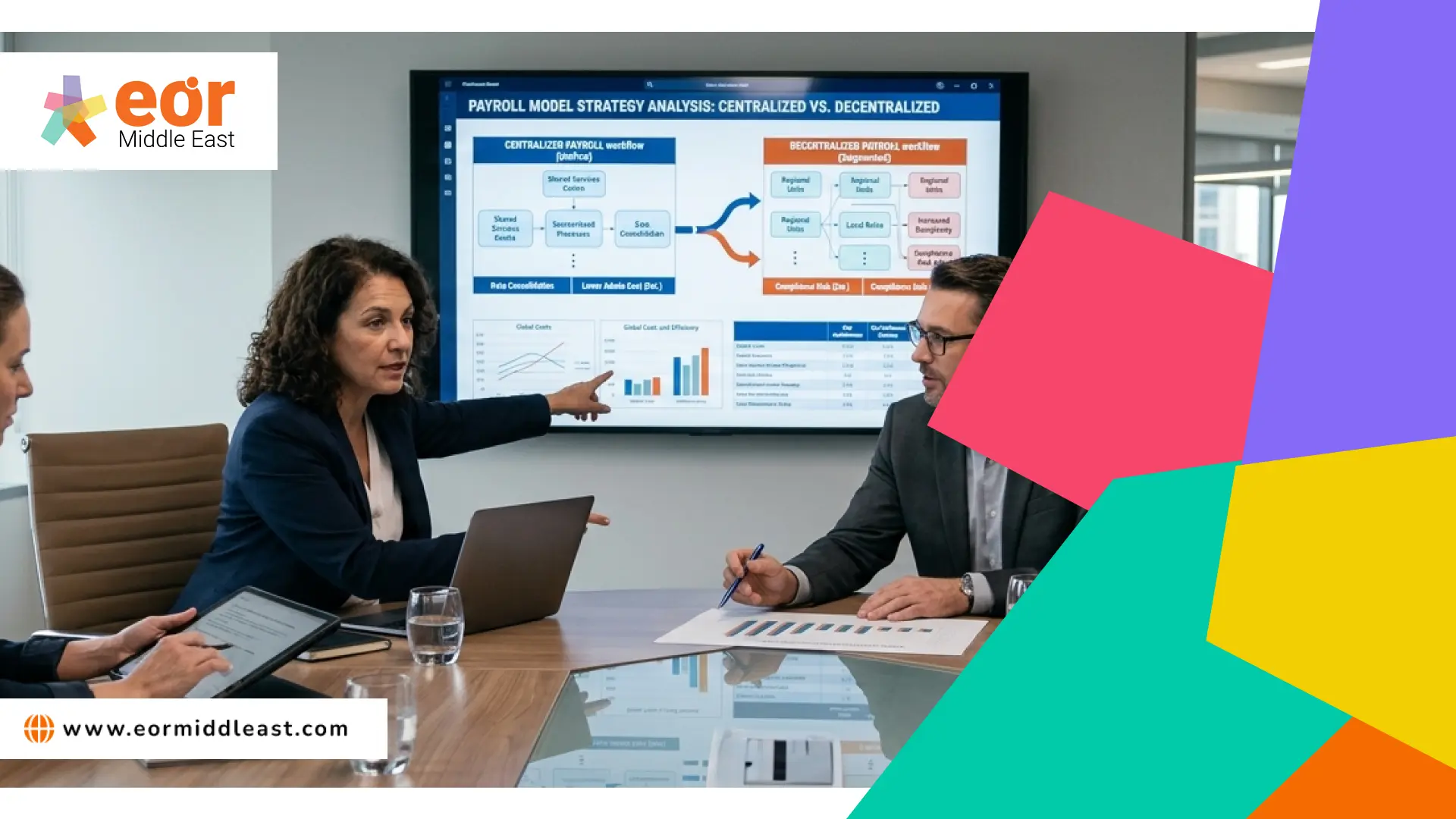
A centralized payroll model manages all payroll operations through one unified system. This is regardless of country, currency, or employment structure.
Payroll governance sits under a central function. It standardizes processes within the organization, rather than every region operating independently.
Key Characteristics:
These are the key features of centralized payroll.
- Single payroll platform processing multiple currencies
- Unified compliance framework adapted to local regulations
- Standardized approval workflows
- Consistent audit trails
- Centralized reporting and analytics
- Single source of truth for payroll data
Core Advantages:
Centralized payroll creates visibility. Your leadership teams can access global payroll reports. The need for consolidating data from multiple vendors is not required. The Finance teams you have can gain greater forecasting accuracy. HR leaders gain consistency within regions.
Additional benefits include:
- Faster approvals and payroll processing
- Reduced risk of payroll discrepancies
- Stronger data governance and security controls
- Lower compliance risk through standardized processes
- Simplified audits and reporting
If you’re an enterprise that is operating across dozens of countries, centralized payroll becomes a strategic asset for you instead of an administrative function.
Best Fit
Centralized payroll works best for mature enterprises. If your organization operates in stable regulatory environments, centralized is the ideal choice for you. Does your company have established HR and finance functions? The centralised model is the better pick. Businesses prioritizing visibility, compliance, and cost efficiency can also rely on this model.
Decentralized Payroll: Local Agility at the Cost of Consistency
A decentralized payroll model distributes payroll responsibilities within regional teams, local entities, or in-country payroll providers. According to local requirements, each country or business unit manages payroll independently.
Key Characteristics
These are the vital features:
- Multiple payroll providers across regions
- Country-specific systems and workflows
- Independent decision-making at the local level
- Flexible adaptation to local regulations
- Strong reliance on in-country expertise
Core Advantages
Decentralized payroll offers speed to employers who are looking for quick operations. If your company is expanding into new markets, you can quickly onboard local payroll partners. You don’t need to wait for enterprise-wide platform implementation.
Other advantages include:
- Faster local decision-making
- Better alignment with country-specific tax structures
- Greater cultural and regulatory adaptability
- Easier market entry into unfamiliar jurisdictions
- Modular scalability
Trade-Offs
However, the flexibility you get with decentralized payroll often comes at a cost.
Common challenges you’ll face are:
- Inconsistent reporting across providers
- Limited global visibility
- Higher cumulative vendor costs
- Duplicate processes and reconciliation work
- Uneven employee experiences between countries
Best Fit
Decentralized payroll is preferred by:
- Fast-growing startups
- International businesses are entering multiple markets rapidly
- Organizations prioritizing local autonomy
- Companies with highly diverse regulatory requirements
Centralized vs Decentralized Payroll Across Key Dimensions
The differences between the two can give you a deeper insight into what’s best for you and why.
| Dimension | Centralized Payroll | Decentralized Payroll |
| Compliance | Central system updates reduce regulatory gaps | Depends on local providers maintaining compliance |
| Data Security | Unified security controls and governance | Multiple vendors create varied security standards |
| Cost Structure | Higher setup cost, lower long-term TCO | Lower upfront cost, higher cumulative expenses |
| Scalability | Structured but slower expansion | Faster market entry and deployment |
| Reporting | Real-time global visibility | Fragmented reporting across regions |
| Employee Experience | Consistent payroll experience | Varies by country and provider |
Compliance Management:
Centralized systems embed local tax rules into a unified framework and automate regulatory updates.
Decentralized models depend on each local provider staying current with changing laws. That creates a higher risk of missed updates and costly penalties.
Research cited by Deloitte indicates that:
“Only 13% of large global organizations operate a purely decentralized payroll model. Centralized structures remain the dominant approach among large enterprises.”
Data Security & Confidentiality:
A company stores some of the most sensitive employee payroll information.
Centralized payroll provides stronger governance through:
- Unified encryption standards
- Access controls, and
- Monitoring.
Decentralized environments expose data within multiple vendors with varying security maturity levels.
Operational Cost Over Time:
Centralized payroll requires a greater upfront investment. However, standardization reduces duplicate work, reconciliation efforts, and vendor management costs over time.
Decentralized models appear cheaper initially. But it becomes expensive as vendor counts increase.
Scalability & Expansion:
Entering new markets? Then, decentralized payroll is a better choice as it wins on speed. You can onboard local providers for your company without redesigning global infrastructure. Whereas centralized models require configuration and integration. This may slow deployment.
Employee Experience:
Every worker you hire expects payroll accuracy regardless of location. Centralized payroll delivers a consistent experience within countries. In contrast, decentralized structures often produce different processes, payment timelines, and support standards.
How Outsourcing Interacts With the Payroll Model?
Multi-country payroll outsourcing becomes strategically important here. Outsourcing doesn’t eliminate the structural challenges you have. It amplifies them.
Centralized + Outsourcing
Centralized payroll pairs exceptionally well with outsourcing. There are many global organizations that use a single provider. They use them to manage payroll across dozens of countries under one service-level agreement.
ADP, CloudPay, and Immedis are the platforms that enable firms to manage multi-country payroll from a centralized interface.
You may enjoy several benefits in the form of simplified vendor management, unified invoicing, standardized compliance processes, better audit readiness, and consolidated reporting.
Quite an effective model for payroll outsourcing for large companies seeking global visibility.
Decentralized + Outsourcing
Companies outsource payroll to multiple in-country payroll partners in decentralized structures. Each provider handles your local compliance, filings, and payments.
Your market entry accelerates, and coordination becomes increasingly difficult as vendor numbers grow. The approach is common in hr and payroll outsourcing arrangements. Particularly where local firms manage payroll and HR functions.
An essential lesson many companies learn too late is that governance decisions should come before provider selection.
Must understand how payroll outsourcing works beforehand. You can start by deciding on the right payroll structure first.
The Hybrid Payroll Model: The Best of Both Worlds?
Modern-day organizations are moving toward a hybrid model. Instead of choosing one extreme, they combine centralized oversight with decentralized execution.
How It Works:
A central payroll function sets policies and standards. They manage governance and oversee reporting for your organization. On your behalf, they control compliance frameworks. Meanwhile, local teams or in-country providers manage execution. This model has gained huge momentum.
Market research shows:
“The hybrid payroll outsourcing segment reached USD15.85 billion in 2024. This reflects growing enterprise adoption.”
Why Companies Prefer It
You might be the next one who is going to pick it, as many companies have done, as hybrid payroll delivers companies global visibility, local compliance expertise, reduced vendor sprawl, better scalability, and stronger governance.
Best Fit
Do not think much and select a hybrid when operating in five or more countries. Hybrid works well if you’re managing diverse regulatory environments. The model is a perfect fit when you have to maintain an internal payroll team. Want to seek local expertise without losing control? Go for a Hybrid payroll. Don’t see it as a compromise. But count it as a strategic operating model.
Which Model Works Best for Payroll Outsourcing for Large Companies?
Complications multiply immediately if you are a firm with thousands of employees across multiple regions. Because of this, payroll outsourcing for large companies trends toward centralized or hybrid models.
Why Large Companies Favor Centralization
Large firms are in favor of centralization due to unified executive reporting, easier compliance audits, single vendor accountability, stronger cybersecurity controls with better forecasting, and workforce planning.
Where Decentralization Still Makes Sense?
If you are a large organization, then you must be looking to gain flexibility. Decentralized execution remains valuable for companies that are newly acquired subsidiaries, highly regulated markets, countries with unique labor laws, and fast expansion initiatives.
Organizations evaluating the pros and cons of outsourcing payroll should prioritize providers. Those partners that combine centralized visibility with local compliance expertise. The strongest ones operate managed global payroll models that balance both.
Real-World Scenarios: Which Model Should You Choose?
The decision should be made by keeping in view the real stories, not assumptions. Get to know each of these one by one.
Scenario 1 —> Fast-Growing Startup Expanding Internationally
A startup enters three countries within a year. Their priority is to gain speed in their operations. The best choice for them is decentralized payroll or Employer of Record solutions.
Scenario 2 —> Mid-Size Company in Eight Countries
If compliance issues are increasing, and employee experiences vary widely, in this situation, the best choice is to move towards a hybrid payroll supported by a single global outsourcing provider.
Scenario 3 —> Enterprise With 15 Payroll Vendors
When a leadership lacks visibility, and Audits are becoming difficult, then the ideal move is consolidation into a centralized global payroll platform.
Scenario 4 —> Expansion into the UAE & Saudi Arabia
If local labor regulations require deep expertise, the perfect solution for them is to choose a hybrid payroll. In this model, trusted in-country specialists within a centralized governance framework are used.
Key Factors: Evaluation Checklist Before Choosing Your Payroll Outsourcing Structure
In the middle of selecting a provider or about to select? You should evaluate the following factors closely.
Number of Countries & Employees
More regions generally strengthen the case for centralized or hybrid models.
Growth Rate
Rapid expansion often favors decentralized execution. Stable operations favor standardization.
Technology Stack
Assess whether your HRIS supports unified payroll integrations.
Regulatory Complexity
India, Saudi Arabia, and the UAE markets require strong local expertise.
Total Cost of Ownership
Evaluate three-year costs, not just implementation fees.
Data Privacy Requirements
Regional data residency and GDPR requirements can highly affect payroll design.
Internal Payroll Capability
Strong internal teams can manage complexity.
Lean teams often benefit from end-to-end managed payroll services.
Structure First, Then Outsource!
The centralized versus decentralized payroll debate isn’t really about payroll. It’s about control versus flexibility. Centralized payroll delivers consistency, visibility, and stronger governance. On the other hand, decentralized payroll provides speed, agility, and local expertise.
The best choice depends on your growth stage, risk tolerance, geographic footprint, and operational goals.
What matters most is understanding that multi-country payroll outsourcing magnifies the strengths and weaknesses of whichever model you choose.
Define your payroll governance structure first. Do it right before evaluating providers. That decision will shape compliance outcomes. It also shapes worker experience, operational efficiency, and lasting scalability.
The most successful organizations design the right payroll operating model before outsourcing begins. You can be the one who takes the right steps at the right time. EOR Middle East’s help is just a step away, leading you to select the payroll model that perfectly fits and matches your organization’s needs.
FAQs
What’s the difference between centralized and decentralized payroll?
Centralized payroll:
It manages all payroll operations through one system or team.
Decentralized payroll:
It distributes payroll responsibilities across local entities, regional teams, or country-specific providers.
Which payroll model works better with outsourcing?
Both can work effectively. However, centralized payroll aligns well with a single global provider. In contrast, decentralized payroll supports multiple local providers and country-specific outsourcing arrangements.
What’s payroll outsourcing? How does it work?
The practice of hiring a third-party provider to manage many procedures under a single approach. Under it come payroll calculations, tax filings, employee payments, compliance reporting, and related administrative tasks. All can be outsourced on behalf of a company.
Is multi-country payroll outsourcing suitable for small companies?
Many small companies use EOR and global payroll providers. They utilize it to manage country-specific payroll requirements. Eliminating the need to build internal payroll teams.
What are the pros and cons of outsourcing payroll with a hybrid model?
Employers experience many advantages and disadvantages of outsourcing payroll with a hybrid model. The top pros include flexibility, local compliance expertise, scalability, and centralized visibility.
Irrespective of many benefits, the model does have many cons, too. This may include the need for clear governance, SLA management, and strong coordination between providers and internal teams.
How does HR and payroll outsourcing differ from payroll-only outsourcing?
Both HR and payroll outsourcing combine payroll processing with broader workforce services, such as:
- Onboarding
- Benefits administration
- Compliance support, and
- Employee management.
Payroll-only outsourcing focuses solely on payroll operations.